
Article · 6 min read
What Is Obstructive Sleep Apnea?
A sleep doctor's full guide to obstructive sleep apnea: what causes it, the signs, and why treatment can change your life.
General information, not medical advice. Read our disclaimer.
Obstructive Sleep Apnea: Key Facts
- OSA causes your airway to repeatedly collapse during sleep, stopping breathing for seconds at a time.
- It can happen dozens or hundreds of times per night without you knowing.
- Common signs include loud snoring, gasping during sleep, and daytime exhaustion.
- Untreated OSA increases the risk of heart disease, stroke, and diabetes.
- Effective treatments include CPAP, oral appliances, and Inspire therapy.
See a Sleep Doctor If
- Your partner notices you stop breathing during sleep
- You feel exhausted despite sleeping 7-8 hours
- You have loud snoring with daytime sleepiness
- You wake up gasping or choking at night
Obstructive sleep apnea (OSA) is a common sleep problem where your airway gets blocked again and again during sleep. It breaks up your sleep and lowers the oxygen in your blood. You need a sleep study to know for sure, and treatment can greatly improve your sleep, energy and health.
What happens during sleep apnea?
OSA is one of the most common sleep problems. It affects millions of people around the world. Even so, many people with sleep apnea do not know they have it. You or your bed partner may notice loud snoring, gasping in sleep, or feeling tired all the time. If so, sleep apnea could be the cause.
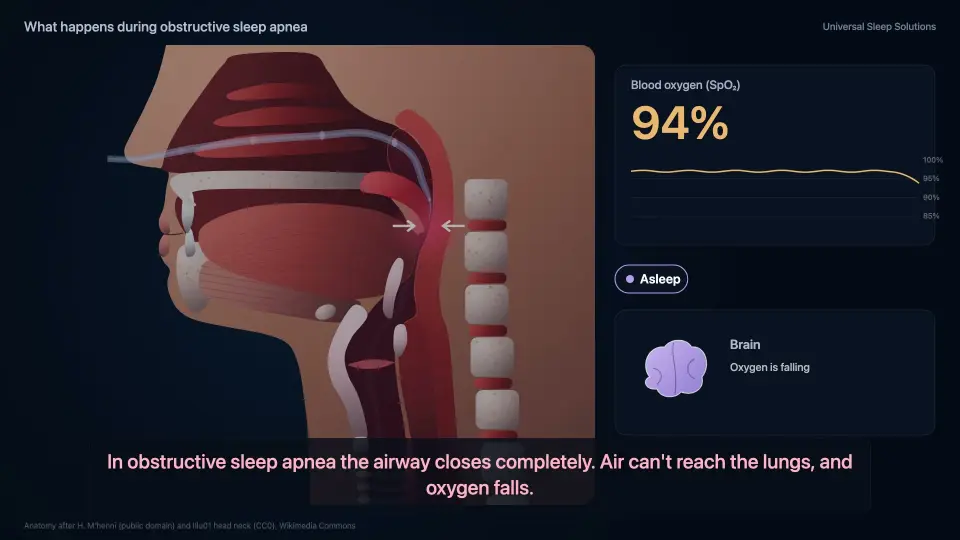
In normal sleep, the muscles in your throat relax. But your airway stays open enough for air to flow freely. In people with OSA, the soft tissue at the back of the throat falls in again and again during sleep. It partly or fully blocks the airway.
When the airway is blocked, your body wakes up for a moment to open it again. This is often so short that you do not remember it. A full block is called an apnea. A partial block is called a hypopnea. They can happen dozens or even hundreds of times a night.
Each one breaks up your sleep. It also lowers the oxygen in your blood. This makes your heart and brain work harder all night. I am a board-certified sleep doctor. I want you to know why getting tested and treated can greatly improve your health and your life.
What are the signs?
Many people with OSA do not know they have a problem. That is because the signs come on slowly. Common signs include:
- Loud snoring most nights — Often noticed by a bed partner.
- Breathing pauses — Someone else sees them during your sleep.
- Gasping or choking — During sleep.
- Feeling very sleepy in the day — Tired even after a full night's sleep.
- Headaches in the morning — When you first wake up.
- Dry mouth or sore throat — When you wake up.
- Trouble focusing — And memory problems.
- Mood changes — Feeling cranky.
- Getting up often at night to pee — More bathroom trips than usual.
Myth: Snoring means you have sleep apnea. Fact: Not all snoring is sleep apnea. But a sleep doctor should check loud snoring that happens most nights. This is even more true if someone has seen you stop breathing.
Who is at risk?
Anyone can get sleep apnea. But some things raise your risk:
- Extra weight — Fat around your upper airway can block breathing.
- Neck size — A thicker neck may mean a narrower airway. This means more than 17 inches around in men, or 16 inches in women.
- Age — OSA is more common in older adults.
- Being male — Men are 2 to 3 times more likely to have sleep apnea.
- Family history — Genes help shape your airway.
- Alcohol and sleeping pills or other sedatives — These relax throat muscles.
- Smoking — It causes swelling and fluid buildup in the upper airway.
- Stuffy nose — A nose that is blocked for a long time raises your risk.
Myth: Only people who are overweight get sleep apnea. Fact: Obesity is a major risk. But sleep apnea can affect people of any weight. The shape of your airway, your genes and other things also play a role.
How is sleep apnea found?
If you think you have sleep apnea, first see a sleep doctor. Your first visit to a sleep clinic is usually a full check-up. Your sleep doctor will talk about your symptoms and go over your health history. They may also ask your bed partner about your sleep. They will look at your airway and suggest the right tests.
The best test for sleep apnea is a sleep study. It can be done in two ways:
- Sleep study in a lab (polysomnography, or PSG) — You spend the night in a sleep lab. It tracks your brain waves, breathing, oxygen levels, heart rate and body movements.
- Home sleep apnea test (HSAT) — A simpler test you do at home. It measures breathing, oxygen levels and airflow.
Your sleep doctor will choose the best test for you. This is based on your symptoms and health history. Many patients feel relief to finally know why they feel this way. They also get a clear path to treatment.
Understanding your results: the AHI
Sleep study results include the Apnea-Hypopnea Index (AHI). It counts how many times per hour your breathing stops or gets shallow during sleep:
- Normal — Fewer than 5 times per hour.
- Mild OSA — 5 to 14 times per hour.
- Moderate OSA — 15 to 29 times per hour.
- Severe OSA — 30 or more times per hour.
How is it treated?
The good news is that sleep apnea can be treated very well. Your sleep doctor will suggest a plan based on how severe it is:
- CPAP therapy — The most common treatment and one that works very well. A CPAP machine blows a steady stream of air through a mask. This keeps your airway open while you sleep.
- BiPAP therapy — Like CPAP, but with two pressure levels. One is for breathing in and one is for breathing out. Some people find it more comfortable.
- Oral appliance therapy — A custom mouth guard made by a dentist. It moves your jaw and tongue forward to keep your airway open. It works best for mild to moderate OSA.
- Inspire therapy — A device placed in your body. It stimulates the hypoglossal nerve, the nerve that moves your tongue, to keep your airway open. It is an option if you cannot use CPAP.
- Lifestyle changes — Losing weight, not drinking alcohol before bed, sleeping on your side and treating a stuffy nose can all help.
- Surgery — Options include UPPP (surgery to remove extra throat tissue), moving the jaw forward, and other procedures. These are for people who do not get better with other treatments.
What happens if sleep apnea is not treated?
If it is not treated, OSA can lead to serious health problems:
- High blood pressure — Including high blood pressure that does not get better with medicine (resistant hypertension).
- Heart problems — Heart disease, heart attack and heart failure.
- Stroke — When blood flow to part of the brain is blocked.
- Type 2 diabetes — And the body not using insulin well (insulin resistance).
- Mood problems — Depression and anxiety.
- Car crashes — From driving while drowsy.
- Lower quality of life — Feeling worse day to day.
SLEEP APNEA · HOW IT HAPPENS
What happens during sleep apnea
Throat relaxes
Soft tissue at the back of your throat falls in.
Airway blocked
Your airway is partly or fully blocked.
Key pointOxygen drops
The oxygen in your blood goes down.
Brain wakes you
You wake for a moment to reopen the airway.
Heart works harder
Your heart and brain work harder all night.
SLEEP APNEA · SEVERITY
AHI: how serious is your sleep apnea?
| AHI (breathing pauses per hour) | |
|---|---|
| Normal | Fewer than 5 |
| Mild OSA | 5 to 14 |
| Moderate OSA | 15 to 29 |
| Severe OSADeciding factor | 30 or more |
Sleep Apnea: From Symptoms to Treatment
- 01
Notice the Signs
Loud snoring, gasping, daytime fatigue, morning headaches — these are your body's warning signals.
- 02
See a Sleep Specialist
A board-certified sleep doctor evaluates your symptoms and recommends testing.
- 03
Get a Sleep Study
An overnight test measures your breathing, oxygen, and sleep quality to confirm the diagnosis.
- 04
Understand Your Results
Your AHI score tells you how severe your sleep apnea is: mild, moderate, or severe.
- 05
Start Treatment
CPAP, oral appliance, or Inspire therapy — your doctor helps find the best option for you.
Sleep apnea is one of the most treatable conditions I see. The right treatment can dramatically improve your energy, mood, and long-term health. Don't ignore the warning signs.
Minal Patel, M.D.
Watch and learn
Common questions
What is the main cause of obstructive sleep apnea?
Can sleep apnea go away on its own?
Is sleep apnea dangerous?
How common is obstructive sleep apnea?
Can children have obstructive sleep apnea?
What is the difference between sleep apnea and snoring?
Trusted medical sources
This page follows guidance and research from leading medical organizations.
Further reading
- AASMObstructive Sleep Apnea
- NHLBISleep Apnea Information
- Mayo ClinicOSA Overview
- NIHSleep Apnea
- AASMObstructive Sleep Apnea
- NHLBISleep Apnea Treatment
Part of our sleep apnea management service.