
Article · 4 min read
How Sleep Apnea Affects Your Heart
Learn about the strong link between obstructive sleep apnea and heart disease, and why treatment matters.
General information, not medical advice. Read our disclaimer.
Sleep Apnea and Heart Health
- Sleep apnea causes repeated oxygen drops that stress the heart and blood vessels.
- Over 50% of sleep apnea patients have high blood pressure.
- OSA increases the risk of heart attack, stroke, and atrial fibrillation.
- Treating sleep apnea with CPAP can lower blood pressure and reduce heart risk.
- If you have heart disease and snore loudly, ask about sleep apnea testing.
Heart Warning Signs with Sleep Apnea
- Resistant high blood pressure (3+ medications)
- Irregular heartbeat or atrial fibrillation
- Chest pain or shortness of breath at night
- History of stroke or heart attack
Sleep apnea causes repeated oxygen drops and blood pressure spikes in sleep, and that can do serious harm to your heart. Untreated sleep apnea raises the risk of high blood pressure, heart attack, stroke and AFib. Treating it, for example with CPAP, can lower blood pressure and reduce heart risk.
How are your heart and sleep linked?
Your heart and your sleep are closely linked. In healthy sleep, your blood pressure drops and your heart rate slows. Your heart and blood vessels get a chance to rest. But sleep apnea breaks up this rest night after night.
As a sleep doctor, I have seen how treating sleep apnea can change lives. It can improve not just sleep, but heart health too. This link matters if you snore loudly or feel worn out in the day. It also matters if you have heart problems.
How does sleep apnea harm the heart?
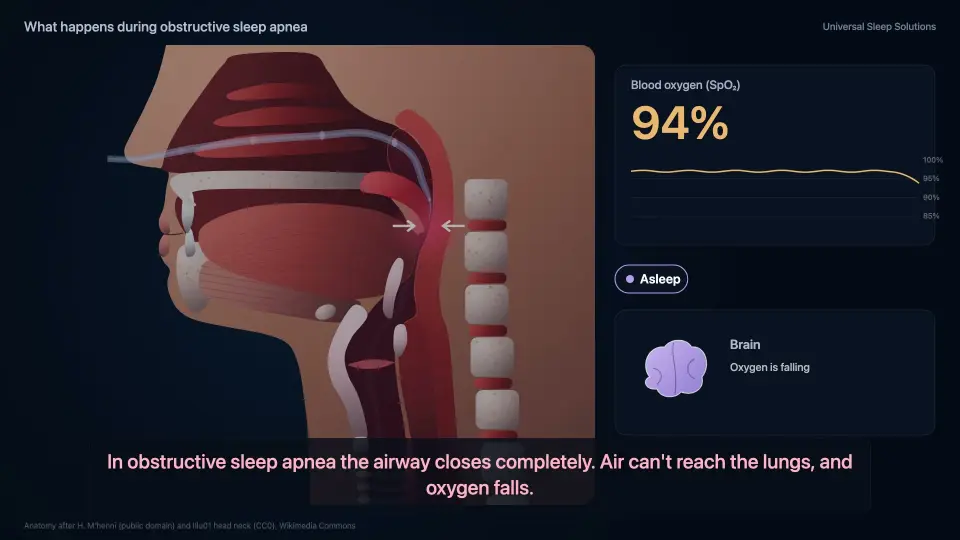
In sleep apnea, your airway closes again and again during sleep. Each time, several things put stress on your heart and blood vessels:
- Oxygen levels drop — Repeated drops in oxygen put stress on blood vessels and organs.
- Stress hormones rise — Adrenaline and cortisol jump each time you briefly wake. This raises blood pressure.
- Blood pressure spikes — Blood pressure should go down in sleep. Instead it jumps up again and again.
- Swelling inside the body goes up — Low oxygen that keeps coming back causes inflammation all through the body.
- The heart works harder — It pumps more blood to make up for low oxygen.
Sleep apnea is a major risk for heart disease. It is not just a sleep problem. It is as big a risk as smoking, high cholesterol and diabetes.
Which heart problems are linked to sleep apnea?
High blood pressure (hypertension)
Sleep apnea is one of the most common causes of resistant hypertension. This is high blood pressure that does not get better with medicine. Up to 80% of people with this kind of high blood pressure have sleep apnea that has not been found.
Heart disease and heart attack
Some people have moderate to severe sleep apnea that is not treated. They have a much higher risk of blocked heart arteries (coronary artery disease) and heart attack. The oxygen drops and blood pressure spikes speed up the buildup of plaque in the arteries (atherosclerosis).
Heart failure
Heart failure means the heart does not pump as well as it should. Up to 50% of people with heart failure have sleep apnea. Nightly drops in oxygen put extra strain on the heart. This can make heart failure worse and make treatment work less well.
Atrial fibrillation (AFib)
AFib is an uneven, often fast heartbeat. People with sleep apnea are 2 to 4 times more likely to get it. Untreated sleep apnea also makes AFib more likely to come back after treatment. This includes a shock to reset the heartbeat (cardioversion) or a procedure called ablation.
Stroke
Severe sleep apnea raises the risk of stroke 2 to 3 times. Blood pressure spikes, swelling and changes in blood clotting all add up. Together they make a stroke more likely.
How does treatment help your heart?
The heart benefits of treating sleep apnea are well proven:
- Blood pressure — It goes down, most of all at night and in the morning.
- Heart rhythm — It becomes steadier, with fewer AFib episodes.
- Inflammation — Signs of inflammation in the blood go down.
- Blood vessels — They work better.
- Heart disease — Overall risk goes down.
Treating sleep apnea is an investment in your heart health. People with heart problems should be checked for sleep apnea.
What are the treatment options?
- CPAP therapy — A machine that blows air through a mask to keep your airway open. It is the most studied treatment. There is strong proof it helps the heart when used every night.
- BiPAP therapy — A machine like CPAP with two pressure levels. It may be better for people with heart failure or complex sleep apnea.
- Inspire therapy — An implanted device for people who cannot use a CPAP or BiPAP machine.
- Weight control — Even losing a moderate amount of weight can help both sleep apnea and heart risk.
SLEEP APNEA · HEART
Heart problems linked to sleep apnea
| What it is | Link to sleep apnea | |
|---|---|---|
| Resistant high blood pressureDeciding factor | High blood pressure that medicine does not fix | Up to 80% have sleep apnea not yet found |
| Heart failure | The heart does not pump as well as it should | Up to 50% have sleep apnea |
| AFib | An uneven, often fast heartbeat | 2 to 4 times more likely |
| Stroke | Blood flow to part of the brain is cut off | Severe sleep apnea raises risk 2 to 3 times |
| Heart attack | Blocked heart arteries | Much higher risk if moderate to severe apnea is untreated |
How Sleep Apnea Damages Your Heart
- 01
Airway Closes
During sleep, your throat muscles relax and block your airway repeatedly.
- 02
Oxygen Drops
Each blockage causes your blood oxygen to fall, sometimes to dangerously low levels.
- 03
Stress Response
Your body releases stress hormones, spiking your heart rate and blood pressure.
- 04
Chronic Damage
Over months and years, this repeated stress leads to high blood pressure and heart disease.
- 05
Treatment Reverses It
CPAP therapy keeps your airway open, protecting your heart from nightly damage.
I work closely with cardiologists because sleep apnea and heart disease go hand in hand. Treating your sleep apnea may be the most effective thing we can do for your blood pressure.
Minal Patel, M.D.
Watch and learn
Common questions
Can sleep apnea cause a heart attack?
Does treating sleep apnea lower blood pressure?
Can sleep apnea cause atrial fibrillation?
Should heart patients be tested for sleep apnea?
Trusted medical sources
This page follows guidance and research from leading medical organizations.
Further reading
- AASMObstructive Sleep Apnea
- NHLBISleep Apnea Information
- Mayo ClinicOSA Overview
- NIHSleep Apnea
- AASMObstructive Sleep Apnea
- NHLBISleep Apnea Treatment