
Article · 2 min read
What Is PAP Titration?
Finding the right pressure for your CPAP or BiPAP is key. Learn how a titration study sets up your treatment.
General information, not medical advice. Read our disclaimer.
CPAP · TITRATION
PAP titration at a glance
- 9 PM-6 AMUsual titration night
- 2Pressures set for BiPAP
- PAP titration finds the best air pressure for your machine.
- Too little pressure fails to treat apnea; too much feels uncomfortable.
- It is done overnight in a lab, or at home with auto-CPAP.
- A split-night study can test and set pressure in one night.
- Your sleep doctor uses the results to set your treatment.
PAP titration is how your care team finds the best air pressure setting for your CPAP or BiPAP machine. The right pressure stops your breathing pauses and still feels comfortable. It is done overnight in a sleep lab, or at home with an auto-CPAP.
What is PAP?
PAP stands for positive airway pressure. CPAP and BiPAP are PAP machines that push air through a mask to keep your airway open. Think of titration as "dialing in" your treatment. The goal is a pressure that stops your breathing problems without making you uncomfortable.
How does a titration study work?
For a titration study in a sleep lab, you wear a CPAP or BiPAP mask while you sleep. A sleep technologist (a trained staff member) watches your sleep from another room. The technologist starts at a low pressure and slowly raises it through the night.
They stop when your apneas, hypopneas and snoring are gone. Apneas are pauses in breathing. Hypopneas are times of very shallow breathing. The technologist watches:
- Breathing — Pauses and shallow breathing at each pressure level
- Oxygen — The oxygen level in your blood
- Snoring — How loud you snore
- Sleep — How well you sleep and what position you sleep in
- Mask fit — How your mask fits and whether air leaks out
What are the types of titration?
- Full-night CPAP titration — The whole night is used to find the right pressure.
- Split-night study — The first half of the night checks for sleep apnea. The second half finds the right pressure.
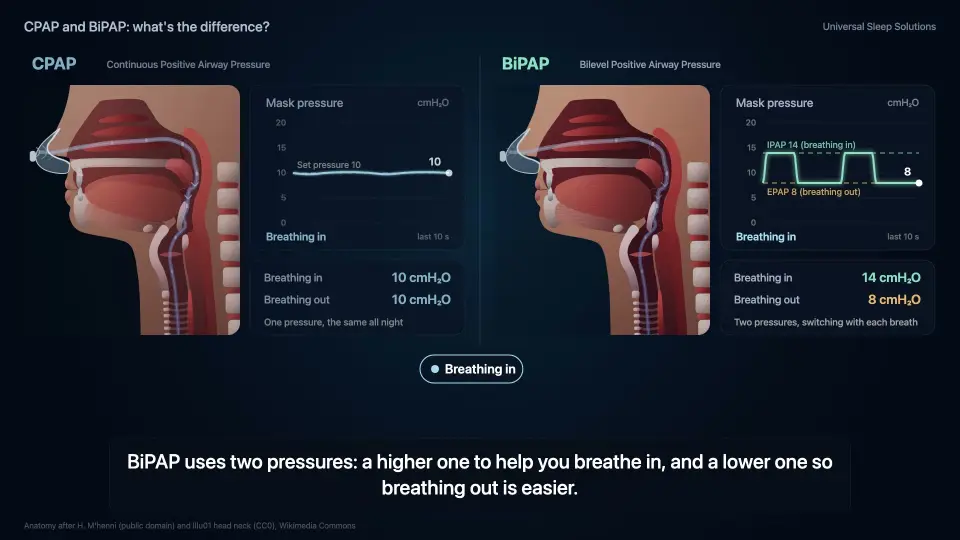
- BiPAP titration — The technologist adjusts two separate pressures: one for breathing in (IPAP) and one for breathing out (EPAP).
- Auto-titration — You use an auto-CPAP machine at home. It finds the best pressure on its own.
What happens after your titration?
Your sleep doctor will look at the results from your study. Then your doctor will prescribe the pressure that best controlled your sleep apnea. The prescription goes to the company that supplies your CPAP. They will set your machine to the right pressure.
CPAP · TITRATION
Types of titration
| Where | How it works | |
|---|---|---|
| Full-night CPAP titration | Sleep lab | The whole night is used to find the right pressure |
| Split-night study | Sleep lab | First half checks for apnea, second half finds pressure |
| BiPAP titration | Sleep lab | Sets two pressures: breathing in (IPAP) and out (EPAP) |
| Auto-titration | Home | An auto-CPAP machine finds the best pressure on its own |
CPAP · TITRATION
How a titration night works
- 1
Mask on for sleep
You sleep in a sleep lab wearing a CPAP or BiPAP mask.
- 2
Start low
A technologist watches from another room and starts the pressure low.
- 3
Raise slowly
Pressure goes up slowly while they watch breathing, oxygen and snoring.
- 4
Find the right level
They stop when breathing pauses, shallow breathing and snoring are gone.
Key point - 5
Get your prescription
Your doctor prescribes the pressure, and your supplier sets your machine.
Watch and learn
Common questions
Why do I need a titration study?
How long does a titration study take?
Do I always need a separate titration study?
Trusted medical sources
This page follows guidance and research from leading medical organizations.
Further reading
- AASMCPAP Therapy
- Sleep FoundationCPAP Machines
- NHLBIPAP Therapy Overview
- AASMObstructive Sleep Apnea
- NHLBISleep Apnea Information
- Mayo ClinicOSA Overview