
Research summary · moderate evidence · 4 min read
After a Stroke or Mini-Stroke: Treating Sleep Apnea to Support Recovery
What recent research shows about testing for and treating sleep apnea after a stroke caused by a clot, or after a mini-stroke.
General information, not medical advice. Read our disclaimer.
SLEEP APNEA · STROKE
Sleep apnea after a stroke at a glance
- About halfLower odds of another stroke
- 4.5hoursAverage nightly CPAP use
- 21Trials in one review
- Sleep apnea is common after a stroke or mini-stroke, but often missed.
- In combined trials, CPAP cut the odds of another stroke about in half.
- CPAP may also help recovery scores, sleepiness and mood.
- Benefits depended on using CPAP well every night.
- Most trials were small and varied, so more research is needed.
Ask about a sleep evaluation if you or your family notice…
- Loud snoring, gasping or pauses in breathing during sleep
- Sleepiness or tiredness that makes rehab harder
- New or worse low mood, or trouble with memory and focus
- Morning headaches, or restless, broken sleep
- High blood pressure or atrial fibrillation (irregular heartbeat)
Treating sleep apnea after a stroke or mini-stroke may help lower the chance of another stroke. It may also help recovery. Recent reviews looked at randomized trials (studies that assign people to groups by chance). People treated with CPAP had fewer repeat strokes and fewer other blood vessel events. They also had better scores on nerve and brain tests and were less sleepy during the day.1,2 But most trials were small and varied in quality. The benefits also depended on how regularly people used CPAP.2,3
How common is sleep apnea after a stroke or TIA?
An ischemic stroke happens when a blood clot blocks blood flow to part of the brain. A transient ischemic attack (TIA) is often called a mini-stroke. It causes stroke-like symptoms that go away. But it is a warning sign that a stroke may come later.
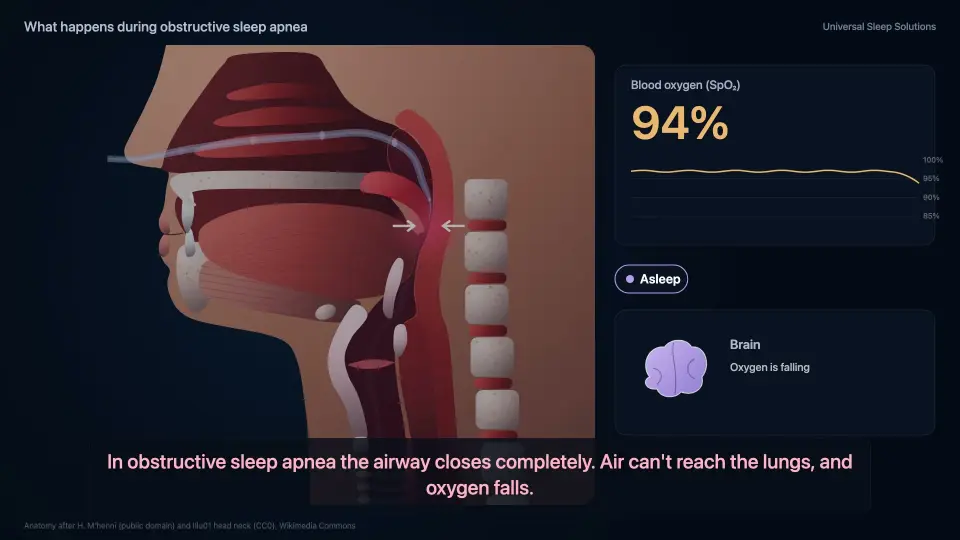
Obstructive sleep apnea (OSA) happens when your throat narrows or closes during sleep. This causes pauses in breathing and drops in oxygen. Doctors measure it with the apnea-hypopnea index (AHI), the number of pauses and shallow breaths per hour of sleep. The wider term sleep-disordered breathing means OSA and other breathing problems during sleep.
Sleep-disordered breathing is common after a stroke or TIA. It raises the risk of a first stroke and of a repeat stroke. It is also linked with tiredness, sleepiness and slower recovery of thinking and movement.2 Even so, sleep apnea is often not found or treated in stroke survivors.1
Can CPAP prevent another stroke?
CPAP (continuous positive airway pressure) is a bedside machine. It gently blows air through a mask to keep your airway open during sleep. Positive airway pressure (PAP) is the general name for CPAP and similar machines.
- 21-trial review — A 2026 review combined 21 randomized trials with 1,457 stroke patients. PAP treatment cut the odds of repeat blood vessel events by more than half.1
- 30-study review — A second 2026 review looked at 30 studies. Seven of them were randomized trials that tracked this. In those trials, CPAP lowered the odds of another stroke or TIA by about half.2
Deaths from any cause did not change in the short randomized trials. Longer observational studies (studies that watch people without assigning treatment) found fewer deaths among CPAP users. But these studies did not account for other differences between the groups, so they are weaker evidence.2
Does treating sleep apnea help stroke recovery?
It may. In the 21-trial review, PAP improved neurological deficit scores. These scores measure problems like weakness or trouble speaking. PAP also lowered daytime sleepiness, eased depression and helped thinking skills. It did not clearly improve functional independence, which means being able to handle daily tasks on your own.1
A 2023 review of 14 randomized trials found that CPAP helped nerve and brain function a little. But it found no clear change in daily function. The trials were very different from one another, so the authors urged caution.3 The second 2026 review found that gains in daily function, thinking and sleepiness were less steady. They depended mostly on how well people kept using CPAP.2
Can stroke survivors really use CPAP?
Many can. In the 2023 review, people used CPAP about 4.5 hours a night on average. The rate of stopping treatment was not very different between groups.3
Still, a stroke can make CPAP harder. Weakness in one arm, trouble speaking or memory changes can make it hard to put on a mask. Family members and caregivers can often help. The right mask and settings make a big difference in comfort.
What are the limits of the research?
The studies are hopeful. But most trials were small, and they varied in design, timing and quality.1,3 The benefits seem to depend on regular use. So getting comfortable with CPAP is an important part of treatment.2 More large, high-quality trials are needed to confirm the results.
When should you get checked?
Ask about a sleep evaluation after a stroke or TIA if you or your family notice:
- Breathing at night — Loud snoring, gasping or pauses in breathing during sleep
- Tiredness — Sleepiness or tiredness that makes rehab harder
- Mood and memory — New or worse low mood, or trouble with memory and focus
- Poor sleep — Morning headaches, or restless, broken sleep
- Heart issues — High blood pressure or atrial fibrillation (an irregular heartbeat)
Even if you do not have clear symptoms, it is fair to ask your doctor if a sleep study makes sense as part of your stroke recovery.
How does Universal Sleep Solutions help?
At Universal Sleep Solutions, we offer sleep studies in our lab and sleep tests you do at home. We set up your CPAP and fit your mask in person. We also see you for follow-up visits. At these visits we fix problems and track how much you use your CPAP.
If you cannot use CPAP, we can look at other options. These include a referral for an oral appliance (a mouthpiece) or Inspire therapy (an implant that keeps your airway open). We work with your neurologist (brain and nerve doctor) and your primary care team.
SLEEP APNEA · STROKE
What CPAP studies found after a stroke
| What studies found | |
|---|---|
| Another stroke or blood vessel eventDeciding factor | Odds cut by about half |
| Nerve and brain test scores | Better in some trials |
| Daytime sleepiness and mood | Better in some trials |
| Handling daily tasks on your own | No clear change |
| Deaths from any cause | No change in short trials |
Trials were small and varied, and benefits depended on regular CPAP use.
Watch and learn
References
- Post-stroke sleep disordered breathing and the effect of positive airway pressure treatment: An updated systematic review and meta-analysis of randomized control trials. Sleep medicine reviews, 2026. PMID 41297370 · doi:10.1016/j.smrv.2025.102207
- Effect of CPAP Therapy in Poststroke Patients with Sleep-Disordered Breathing: A Systematic Review and Meta-Analysis. European neurology, 2026. PMID 41790582 · doi:10.1159/000551243
- Effectiveness and feasibility of continuous positive airway pressure in patients with stroke and sleep apnea: a meta-analysis of randomized trials. Journal of clinical sleep medicine : JCSM : official publication of the American Academy of Sleep Medicine, 2023. PMID 37664950 · doi:10.5664/jcsm.10680
Common questions
Is sleep apnea common after a stroke?
Can CPAP lower my risk of another stroke?
Can you use CPAP if a stroke weakened your hand or arm?
Does CPAP help recovery after a stroke?
Trusted medical sources
This page follows guidance and research from leading medical organizations.
Further reading
- AHASleep Apnea and Heart Disease
- NHLBISleep Apnea & Cardiovascular Risk
- AASMObstructive Sleep Apnea
- NHLBISleep Apnea Information
- Mayo ClinicOSA Overview
- NIHSleep Apnea